
There’s a particular kind of discomfort that settles over a room when a child runs unchecked through a crowded restaurant, and the parent at the table doesn’t even look up. Nobody wants to be the judging bystander, yet most people have been that bystander at some point. The feeling isn’t about being harsh toward parents. Raising children in public is genuinely hard.
What observers notice, though, aren’t the moments of struggle. It’s the patterns. Specific, repeated behaviors that suggest a child has never really been taught where the line is. The erosion or absence of clear boundaries between parents and children has emerged as a significant issue in modern parenting research, and its effects tend to show up most visibly in public spaces, where expectations and other people coexist in the same room.
1. Letting Kids Interrupt Adult Conversations Without Consequence

1. Letting Kids Interrupt Adult Conversations Without Consequence (Image Credits: Pexels)
It happens at the coffee shop, at the checkout line, sometimes even mid-sentence during a serious exchange. A child cuts in, the parent stops entirely, and the interrupted adult is simply left hanging. There’s no acknowledgment, no gentle redirection, just a pivot straight to the child’s wants.
For most parents, setting basic behavioral expectations is second nature early on: no hitting, don’t interrupt, don’t grab things out of other kids’ hands. As children get older, though, social interaction grows more complex. Allowing interruptions to go unchecked in public sends a clear signal that the child’s impulse outranks everyone else in the room, including the adults the parent is speaking with.
2. Caving to Tantrums on the Spot

2. Caving to Tantrums on the Spot (Image Credits: Pexels)
A child asks for something, gets told no, escalates immediately, and within thirty seconds the parent reverses course. Onlookers catch every beat of this exchange, and it’s hard to miss what’s really happening. The tantrum worked, and the child now knows it.
Young children quickly learn that many parents will give in quickly at just the hint of a public tantrum. Children may realize this and know that they will get a parent’s attention and focus if they misbehave. When children of permissive parents don’t get what they want, they may become impulsive, selfish, and demanding. Giving in during a public meltdown doesn’t just affect that moment. It reinforces a negotiating tactic the child will keep using.
3. Ignoring a Child Who Is Disrupting Other People

3. Ignoring a Child Who Is Disrupting Other People (Image Credits: Pexels)
A toddler kicks the back of a stranger’s airplane seat repeatedly. A school-age child shrieks at high volume in a quiet waiting room. The parent watches their phone. This isn’t about expecting perfect children. It’s about the parent’s visible indifference to how their child’s behavior is affecting everyone nearby.
Children of permissive parents may exhibit self-centeredness and a disregard for authority due to the absence of clear limits. When a parent does nothing in these situations, they aren’t just failing the people around them. They’re also failing the child, who never learns that shared spaces come with shared responsibilities. Other people aren’t invisible.
4. Making Empty Threats With No Follow-Through

4. Making Empty Threats With No Follow-Through (Image Credits: Pexels)
The count-to-three that never leads anywhere. The “we’re leaving right now” that the family never acts on. Bystanders often hear these warnings loop three, four, five times with zero consequence attached. The child barely registers them at this point.
Parents should only give consequences they actually intend to follow through on. Threats to leave a public location without actually doing so will result in the child learning that they do not have to listen because the parent does not mean what they say. Permissive parents often refuse to or simply cannot set limits, and when they do attempt to, they tend to be inconsistent. That inconsistency is hard to hide in public.
5. Allowing Children to Run Freely in Spaces Meant for Adults

5. Allowing Children to Run Freely in Spaces Meant for Adults (Image Credits: Pexels)
Fine dining rooms, quiet museum halls, busy grocery store aisles during peak hours. Some parents treat these as open playgrounds, letting children race, weave between strangers, and bump into displays while the parent drifts several steps behind. The unspoken message is that the child’s comfort trumps the shared environment.
Without a framework of appropriate limits, children may not learn mature behavior or how to handle the inevitable disappointments of real life. Teaching a child that certain spaces require different behavior is a basic social skill. It’s not restrictive parenting. It’s preparation for a world that won’t accommodate unlimited movement.
6. Negotiating Rules Mid-Meltdown in Front of Everyone

6. Negotiating Rules Mid-Meltdown in Front of Everyone (Image Credits: Unsplash)
Rather than holding a previously set expectation, some parents begin actively negotiating terms once a public scene starts brewing. The child names their demands, the parent suggests a compromise, and the whole exchange unfolds loudly with an audience. It looks less like parenting and more like a hostage situation in the cereal aisle.
Research on parenting styles suggests that in balanced families, rules are flexible and open for discussion, but authoritative parents still have the final say, typically only after carefully considering the child’s input. The difference is timing. Negotiating at home, calmly, teaches reasoning. Renegotiating everything under pressure in public teaches a child that escalation gets results.
7. Letting Kids Use Devices at Full Volume Without Headphones

7. Letting Kids Use Devices at Full Volume Without Headphones (Image Credits: Unsplash)
Tablets blasting cartoon soundtracks in restaurants, phone games chiming at full blast in waiting rooms, video calls with relatives echoing through airport gates. This one has become remarkably common, and it tends to radiate outward to every table or seat within a wide radius.
Screen time is often not monitored in permissive households, which can contribute to patterns where children’s device use goes unregulated. Extending that dynamic into public spaces adds another layer, because now everyone else is experiencing it too. Headphones exist, they work, and choosing not to use them in shared spaces is a choice that lands on everyone nearby.
8. Responding to Rudeness With Laughter or Approval

8. Responding to Rudeness With Laughter or Approval (Image Credits: Pexels)
A child says something dismissive or genuinely unkind to a stranger, a server, or another child, and the parent smiles, chuckles, or says something like “oh, he just says whatever he thinks.” The bystander who just received the brunt of that comment is left wondering whether to react or absorb it silently.
Modeling respectful behavior is crucial, as children learn boundary-setting when they see parents checking with others and responding to social situations appropriately. When rudeness is met with amusement, the child receives clear feedback that this behavior is acceptable or even charming. It tends not to stay charming for long as children get older.
9. Overriding a Child's "No" in Social Situations, Then Calling It Cute

9. Overriding a Child's "No" in Social Situations, Then Calling It Cute (Image Credits: Pexels)
This one is subtler, but observers do notice. A child clearly doesn’t want to be hugged by a relative or touched by an overly enthusiastic stranger, and the parent nudges them anyway. “Give grandma a hug, don’t be shy.” The child’s hesitation is treated as something to override rather than something to respect.
As children get older and social interaction becomes more complex, it’s not enough to just teach behavioral rules. They need to learn to set boundaries for themselves and to respect those of others. Pushing past a child’s expressed discomfort in social situations, even with good intentions, teaches a confusing lesson about whose comfort takes priority.
10. Treating Restaurant or Store Staff as Props in Parenting Moments
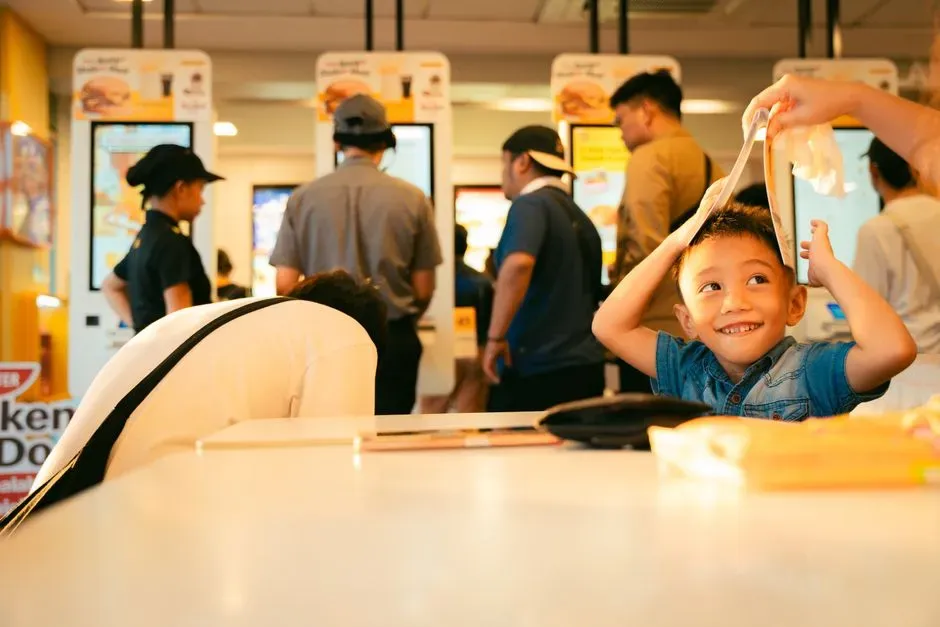
10. Treating Restaurant or Store Staff as Props in Parenting Moments (Image Credits: Pexels)
Some parents put servers, cashiers, or store employees in awkward positions by using them as teaching tools without asking. “Tell the nice lady what you want to eat.” “Say sorry to him for what you did.” The staff member now has to perform a role they didn’t sign up for, often while managing their actual job responsibilities.
Permissive parents often hold minimal expectations for their children, impose few rules, and allow their children to navigate situations independently, sometimes taking on a more friend-like role rather than guiding behavior proactively. This creates gaps in social preparation that then get outsourced, sometimes to strangers who have no real choice in the matter.
11. Letting Children Demand Preferential Treatment From Other People's Children

11. Letting Children Demand Preferential Treatment From Other People's Children (Image Credits: Pexels)
At the playground, one child declares that the swing belongs to them indefinitely. At the library table, another child decides that every crayon is theirs. The parent watches nearby, occasionally murmuring something soft and non-committal, but never actually stepping in to redirect the behavior.
Children of permissive parents often believe they can get away with anything without consequences. This lack of structure can lead to challenges in managing responsibilities and adhering to societal expectations, potentially resulting in impulsive behavior. Other children and their parents pick up on this dynamic almost immediately. The playground has a social economy, and children who never learn to participate in it fairly tend to stand out.
12. Refusing to Exit a Space When a Child Is Clearly Overwhelmed
12. Refusing to Exit a Space When a Child Is Clearly Overwhelmed (Image Credits: Pexels)
The child has been overstimulated for twenty minutes. The signs are obvious to everyone in the vicinity. The parent continues shopping, eating, or socializing anyway, seemingly determined to outlast the situation rather than respond to it. The meltdown escalates, and the whole room becomes collateral.
Visits to doctor’s offices, restaurants, and shopping trips can simply take too long for small children. Children who are four or five usually cannot remain compliant and well-behaved for over two hours, and children may not know what to expect in public situations, making them anxious and more likely to act out. If a child is having a tantrum, moving to a quiet location and letting the outburst run its course until the child is calm is a far more effective strategy than staying put and hoping it resolves itself.
None of these behaviors make someone a bad parent. Parenting in public is exhausting, unpredictable, and often humbling. What these moments do reflect, though, is a consistent pattern that researchers and child development experts have studied closely. Healthy boundary-based parenting, characterized by authoritative parenting, consistent monitoring, and clear limit-setting, is significantly linked with lower levels of disruptive and deviant behavior in children.
The bystanders watching aren’t judging the child. Most of them understand that kids are works in progress. What they’re really seeing is whether the parent is doing the quiet, consistent work of setting limits that will serve the child long after the grocery run is over.