
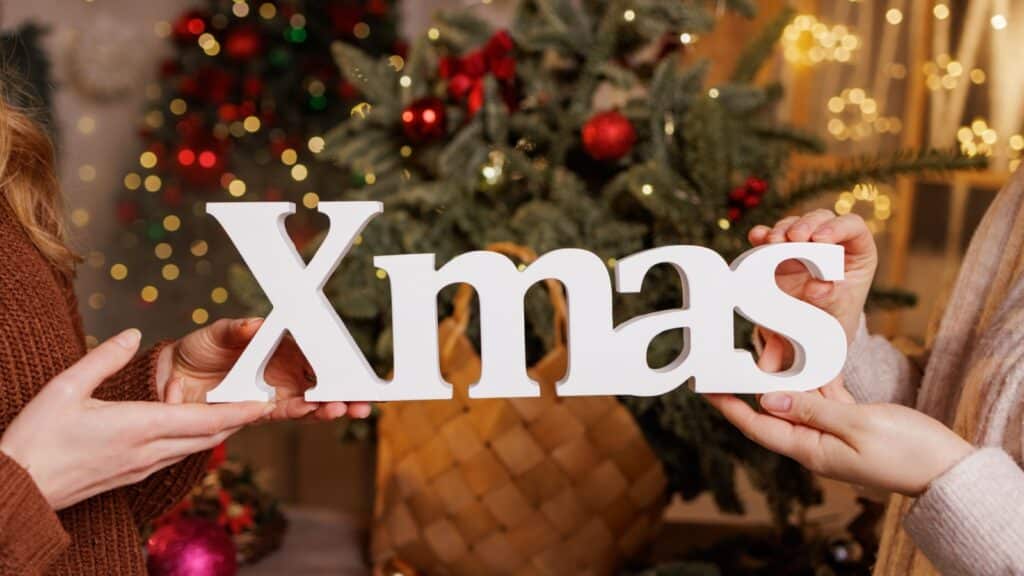
It’s quite normal to see the phrase “Xmas” on signs and cards around the festive season. In fact, it’s become so common that some people are using it instead of the full word, Christmas. But despite what some people say, the shorter version isn’t actually modern slang. Let’s find out about the history of Xmas and why the word has become so popular.
The “X” comes from the Greek name for Christ
Many people assume that the X in Xmas is something that people came up with recently. However, the use of the letter actually comes from Greek. Christ’s name is spelled Χριστός in Greek, and the first letter, chi, looks exactly like our X. It’s because of that similarity that early Christians used Χ to stand for Christ’s name, whether by itself or mixed with other Greek letters.
It was especially common to use X in sacred writing & artwork. In fact, the Chi-Rho symbol actually comes from this idea as a combination of chi (Χ) and rho (Ρ). The X in Xmas is a lot older than most people expect.
Xmas has been in English for centuries
The abbreviation “Xmas” began appearing in written English in the 1500s, with some similar forms actually appearing earlier. Many older English writings sometimes use “Xtian” for “Christian” and “Xtianity” for “Christianity.”
So where did the name “Christmas” actually come from? You can trace it back to the Old English phrase “Cristes mæsse,” and that shows that the short version, Xmas, didn’t replace anything. It’s one that simply emerged alongside older spellings, and both forms stayed in use long enough that many modern dictionaries track them separately.
Why modern writers use Xmas
The roots of “Xmas” are clearly quite old. But the reason you’ll see the phrase being used so often today is for one simple reason. Space. Whenever someone has limited room, like on signs or storefront banners, as well as printed ads, the shorter spelling is much better.
It also works well to use a short word when you’re writing fast or trying to squeeze a message onto a single line. Rather than being a statement, “Xmas” is often a practical phrase.
Style guides and writers who prefer “Christmas”
There are some editors and guidebooks that go the opposite way. A few style references suggest that you should use “Christmas” in formal writing so that it’s clearer for readers. Older etiquette books also used to recommend using the full word for greeting cards.
But then there are also several language guides that treat “Xmas” as simply an informal phrase. They argue that it’s not wrong, merely something that is better suited for casual notes and cards. The spelling of Christmas that people choose often comes down to the tone they want to convey, rather than any particular rule.
Why some Christians see Xmas as “taking Christ out”
Quite a few Christians react rather strongly to people using “Xmas.” They believe we should keep Christ front and center during December, so for them, anything that reduces His name is wrong.
It’s something that Franklin Graham, the CEO of Samaritan’s Purse, actually spoke about. He essentially said that saying “Merry Xmas” pushes Jesus out of Christmas, and he said that the phrase is a “war against the name of Jesus Christ.”
One poll by Christianity Today actually found that a large portion of Christians are bothered by the abbreviation, and the feeling was especially common among evangelicals. They believe that shortening the name is disrespectful to Jesus.
Xmas in “war on Christmas” debates
Xmas is often a big part of the discussions about the supposed “war on Christmas.” It’s often used as an example of how Christmas is being de-Christianized. Such an idea has been repeated for decades in conservative Christian media, usually alongside concerns about greetings and anything that seems to be less overtly religious.
It’s due to this that some people think that “Xmas” is a recent cultural trend. But the spelling has centuries behind it. A few people still stick with the full name because of how they were taught or how the shorter version feels to them. The choice to say “Christmas” becomes a matter of conscience rather than a rule.