
Growing up in the 1990s and early 2000s meant absorbing a set of unwritten rules about how to feel, how to behave, and how much to ask for. Many of those rules felt as natural as the air around them. Nobody questioned them, because nobody needed to. That’s just how families worked.
The distance between then and now is, in some ways, stunning. Millennials are described as the first generation to have resources such as self-help books and therapy to understand how childhood can affect them into adulthood. What that awareness revealed wasn’t pretty. A lot of what passed for normal parenting has since been re-examined, reframed, and, in many cases, flagged as genuinely harmful. Here are six of the most common patterns.
1. Being Told to "Stop Crying" and "Toughen Up"

1. Being Told to "Stop Crying" and "Toughen Up" (Image Credits: Unsplash)
For millions of millennial kids, expressing sadness or distress in front of a parent meant being told to stop. Immediately. The phrases came in many forms: "I'll give you something to cry about," "big boys don't cry," or simply "you're fine." If you heard some version of these phrases growing up, you probably absorbed a lesson that emotions are inconvenient, expressing them is weakness, and the fastest way to earn approval was to go quiet.
The long-term damage is real and well-documented. A meta-analysis published in Frontiers in Psychiatry examined alexithymia as a mediator between adverse childhood experiences and the development of psychopathology, and researchers found that emotional abuse and emotional neglect had a greater influence on the development of alexithymia than physical abuse or sexual abuse. Alexithymia is the clinical term for difficulty identifying and describing your own emotions. The adult who was taught to suppress emotions as a child doesn't walk around feeling numb – they function and maintain relationships, but internally they experience a persistent disconnect between what's happening in their body and their ability to interpret it, feeling a tightness in their chest without knowing if it's anxiety, anger, sadness, or something else.
2. Fear-Based Discipline as a Standard Parenting Tool
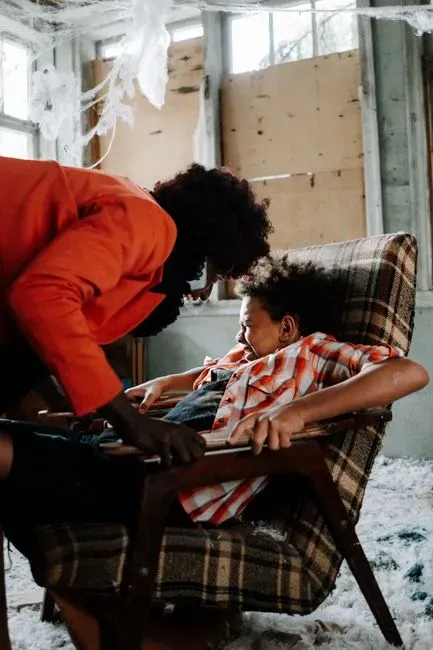
2. Fear-Based Discipline as a Standard Parenting Tool (Image Credits: Pexels)
Boomer-era parenting was often shaped by hierarchy, dictatorship, and survival-based values. Many parents of that generation were doing the best they could with what they had, but emotional safety was rarely the priority – obedience was. Punishments were frequently disproportionate, threats were treated as motivational tools, and children were expected to comply without question or negotiation.
Fear-based discipline teaches children to comply, not to feel safe, and to behave, not to trust. Therapists working with millennial adults consistently identify this pattern as a source of lasting anxiety, hypervigilance, and difficulty with authority figures later in life. Research underscores the role of adverse childhood experiences, with toxic parenting identified as a critical factor leading to depression, anxiety, and difficulty in forming healthy relationships.
3. Parentification: Being the Emotional Caretaker for Adults

3. Parentification: Being the Emotional Caretaker for Adults (Image Credits: Pexels)
Many millennials grew up as the de facto emotional support for one or both parents. Sometimes it was overt – a mother who confided divorce details to her ten-year-old, or a father who leaned on his eldest child to manage family stress. Often it was subtler: always being the one who kept the peace, read the room, and made sure everyone else was okay. It felt like closeness. Therapists now have a name for it.
In enmeshed families, parents may rely too heavily on their children for emotional support, treating them more like peers or confidantes, and this over-reliance on the child can lead to parentification, where children take on roles and responsibilities inappropriate for their age. The cost of that misplaced role-playing follows children well into adulthood. The hyper-responsibility associated with parentification can lead to emotional and physical exhaustion, with parentified individuals unable to take breaks from caretaking roles or emotional labor. The child who becomes an emotional caretaker grows up more focused on other people's emotions, suppresses their own, and feels responsible for managing others' feelings.
4. Conditional Love Tied to Performance and Achievement

4. Conditional Love Tied to Performance and Achievement (Image Credits: Unsplash)
A gold star on the fridge, praise that only arrived when grades were good, silence or withdrawal when expectations weren't met. For a large portion of millennial kids, love felt like something that had to be earned rather than something that was simply there. The distinction matters enormously in terms of psychological development.
Love was often assumed rather than spoken, and fear-based language was normalized as discipline or motivation – with phrases like "I'll give you something to cry about" reinforcing a power dynamic where children learned that safety, autonomy, and even belonging were conditional. Therapists now recognize this pattern as a core driver of perfectionism, chronic people-pleasing, and an anxious attachment style in adult relationships. Research findings reveal patterns of emotional, physical, and psychological abuse contributing to long-term mental health issues and impaired social functioning – and conditional affection sits squarely within that category, even when the intent was never to harm.
5. Being Dismissed for Having Boundaries or Preferences

5. Being Dismissed for Having Boundaries or Preferences (Image Credits: Unsplash)
Saying no to a relative's hug was met with a lecture about respect. Expressing a preference that differed from the family's was labeled selfishness. Privacy was treated as suspicious rather than healthy. Children who pushed back were called difficult, ungrateful, or disrespectful – and they learned, quickly, that having a distinct inner life came with social penalties.
Enmeshed parenting refers to a dysfunctional family dynamic in which parent-child boundaries are blurred, roles are mixed up, and a child's autonomy is stifled. Developmentally, children require space for differentiation, peer bonding, and identity formation – and when a child becomes the primary emotional regulator for a parent, that space is restricted. Adults who grew up in such environments often arrive in therapy describing a pattern that feels entirely familiar to clinicians: they cannot say no, they don't know what they actually want, and they feel guilty any time they prioritize themselves. The lack of clear boundaries in childhood, where the child had to take on adult responsibilities, can result in difficulty asserting oneself in adulthood, with individuals having trouble turning down requests from others because they feel they must constantly fulfill others' needs.
6. Normalizing Overwork and Busyness as Moral Virtues

6. Normalizing Overwork and Busyness as Moral Virtues (Image Credits: Pexels)
Rest was lazy. Asking for help was weakness. Being exhausted was almost a badge of honor. Millennial children watched parents work relentlessly and absorbed the implicit message: your worth is proportional to your output. Downtime was something you had to earn, not something that was simply allowed.
For some millennials and the generations before them, childhood was peppered with patterns and phrases that were deployed as normal, with parents seen as doing their best, often passing down a survival mode they had inherited themselves. The clinical fallout of this particular conditioning is increasingly visible. According to mental health data, therapists say the most common concerns bringing clients to therapy are anxiety or stress, followed by depression and trauma – and clinicians frequently trace anxiety and burnout patterns directly back to a childhood framework in which constant productivity was the only acceptable way to exist. Millennials are now actively rewriting the parenting playbook, ushering in a new era of open communication and emotional intelligence with their kids – which itself suggests a quiet, collective acknowledgment that the old framework left significant damage behind.
What makes these six patterns so tricky is that none of them required malicious intent. Most parents who raised millennials were genuinely doing their best within the emotional vocabulary they had inherited. Recognizing the harm isn't about assigning blame. It's about understanding why so many millennials arrived in therapy in their twenties and thirties carrying wounds they couldn't even name – because no one had ever told them the wounds existed in the first place.