
There was a time when hitting one million dollars in net worth felt like the definitive mark of financial success. For decades, that number carried a kind of cultural gravity, shorthand for having made it. Today, that same million buys a lot less peace of mind, and the financial community has adjusted its expectations accordingly.
The number most commonly cited now sits closer to two and a half million, though it shifts depending on who you ask, where they live, and which generation they belong to. What’s clear is that the threshold for “wealthy” is a moving target, shaped by inflation, rising asset prices, and a growing gap between what most people own and what they believe they’d need to feel truly secure.
The Number Americans Actually Cite

The Number Americans Actually Cite (Image Credits: Pexels)
According to Schwab's 2024 Modern Wealth Survey, Americans said it takes an average net worth of $2.5 million to qualify as wealthy, a bit of an uptick from $2.2 million in the surveys from 2022 and 2023. That upward creep is notable. It tracks closely with inflation and with the surge in home values and stock prices that defined the post-pandemic years.
The 2025 Schwab survey, which polled 2,000 adults nationwide, saw that figure slip back slightly to $2.3 million. While the wealth benchmark decreased, nearly two-thirds of respondents said it feels harder to reach. Inflation, high interest rates, and broader economic uncertainty were the most commonly cited reasons. The perception of difficulty, in other words, is rising even as the nominal target edges down.
What "Financially Comfortable" Actually Means

What "Financially Comfortable" Actually Means (Image Credits: Pexels)
The average response for what it takes to be considered "financially comfortable" in the 2025 Schwab survey was $839,000. That's a meaningful distinction. Comfortable and wealthy aren't the same thing, and most people seem to understand that intuitively.
This distinction speaks to different levels of financial aspiration. Financial comfort typically implies freedom from monetary stress, the ability to manage unexpected expenses, and having sufficient resources for reasonable lifestyle goals. Wealthy, by contrast, implies something more expansive. It's the difference between not worrying about the bills and genuinely not having to think about money at all.
Where the Wealth Percentiles Actually Land

Where the Wealth Percentiles Actually Land (Image Credits: Pexels)
The threshold to be in the top ten percent of U.S. households by net worth grew from about $1.3 million to roughly $1.8 million over the last five years, largely due to rising stock and home values. That figure reflects the value of what households own, including homes, vehicles, savings, retirement accounts, and investments, minus any debts.
The top five percent of Americans have a net worth beginning at around $1.17 million, while the top two percent threshold starts at about $2.7 million. The most exclusive tier, the top one percent, requires a substantially higher net worth of approximately $11.6 million. That gap between the two percent and the one percent is striking. It's a reminder of just how steep the curve gets at the very top.
The Growing Gap Between Perception and Reality

The Growing Gap Between Perception and Reality (Image Credits: Pexels)
The median U.S. family net worth is approximately $192,900, meaning half of all families have less than this amount and half have more. In stark contrast, the average mean net worth is about $1,063,700, over five times higher than the median. This dramatic difference results from the concentration of wealth among the wealthiest Americans, which pulls the average upward while not affecting the median.
The middle half of Americans have a net worth between $27,000 and $659,000. Approximately eight percent of households have a negative net worth, owing more than they own, while only ten percent have a net worth exceeding $970,900. Set against the $2.3 million figure most people associate with wealth, those numbers make the gap between aspiration and reality very clear.
How the Richest Tier Compares
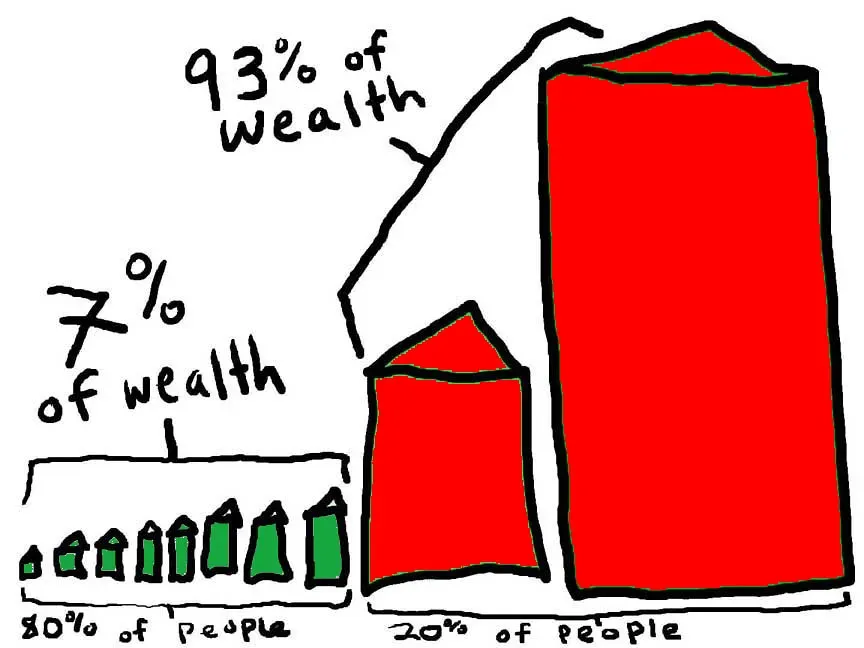
How the Richest Tier Compares (Sustainable Economies Law Center, Flickr, <a href="https://creativecommons.org/licenses/by-sa/2.0/" target="_blank" rel="noopener">CC BY-SA 2.0</a>)
For the fourth quarter of 2024, the top ten percent of households by wealth had $8.1 million on average. As a group, they held 67.2 percent of total household wealth. The bottom fifty percent of households by wealth had $60,000 on average. That contrast is difficult to overstate. Two groups living in the same country, under the same economic system, separated by a factor of more than one hundred.
Federal Reserve data shows that the richest ten percent of American households now own over two-thirds of the nation's total wealth. As of the first quarter of 2024, the top one percent of households in the United States held 30.5 percent of the country's wealth, while the bottom fifty percent held 2.5 percent. These figures put the wealth threshold conversation in a broader context that goes well beyond personal finance.
How Geography Changes Everything

How Geography Changes Everything (Ken Lund, Flickr, <a href="https://creativecommons.org/licenses/by-sa/2.0/" target="_blank" rel="noopener">CC BY-SA 2.0</a>)
Location plays a crucial role when discussing wealth in the United States. The cost of living, job markets, and local economies vary significantly across the country, leading to substantial differences in what's considered wealthy from one city to another. In San Francisco, for example, the threshold for being considered wealthy is a staggering $4.4 million.
Americans say you need the highest net worth to be considered rich in Western states, including California, Washington, and Colorado. That may be unsurprising given the region's high cost of living, especially in California, where major cities like San Francisco and Los Angeles are among the most expensive places in the country, particularly for housing costs. In lower-cost states, the picture looks considerably different, and a smaller number can carry far more practical weight.
How Different Generations Define Wealthy

How Different Generations Define Wealthy (Image Credits: Pexels)
The Charles Schwab survey showed that compared with other generations, Gen Z tends to set lower thresholds for what it takes to be wealthy, at $1.7 million. Meanwhile, millennials and Gen Xers say it takes $2.1 million to be wealthy, and baby boomers set the bar at $2.8 million.
Baby boomers witnessed periods of strong economic growth and more affordable housing, while younger generations have faced rising education costs, challenging job markets, and increasingly unaffordable housing. These experiences shape how each generation views financial success and security. It's less about disagreement and more about lived context. The generation that bought a house for $80,000 and the one that's competing for the same house at $600,000 are measuring from very different starting lines.
How the Industry Formally Classifies Wealth

How the Industry Formally Classifies Wealth (Image Credits: Pexels)
Individuals with one million dollars in liquid assets are generally classified as having a high net worth. To be considered very high net worth, one might need assets ranging from five million to ten million dollars, while ultra-high net worth status could require thirty million dollars or more. These are not casual estimates. They're the classifications that determine which financial products and services clients get access to.
Between 2020 and 2024, the threshold for the top ten percent of net worth grew about forty percent, compared with about twenty-three percent for income. Broader indicators tell the same story: the U.S. median home price rose about twenty-five percent over the last five years, and the S&P 500 gained roughly one hundred and nine percent. The gap between asset growth and wage growth is one of the main reasons these thresholds keep moving upward, even when public perception of the wealth number occasionally dips.
The Psychological Side of the Wealth Threshold

The Psychological Side of the Wealth Threshold (Image Credits: Unsplash)
Financial independence, meaning having sufficient resources to live without needing to work, represents a form of wealth that may require far less than $2.5 million for some, particularly in areas with lower living costs. Conversely, even high-net-worth individuals may not feel "rich" if they lack time, freedom, or purpose. That's the part no survey can fully capture.
Research consistently shows that additional money has diminishing returns on happiness and life satisfaction beyond meeting basic needs and achieving reasonable comfort. Relationships, health, purposeful work, and community connections often contribute more significantly to overall well-being than additional wealth beyond certain thresholds. The number on a balance sheet and the feeling of being wealthy don't always point in the same direction, and that tension is one of the more honest things the data reveals.
The Threshold Is Real, but It Keeps Moving

The Threshold Is Real, but It Keeps Moving (Image Credits: Pexels)
While the reported $2.3 million was a slight drop from last year's Modern Wealth Survey at $2.5 million, it's still twenty-one percent higher than the 2021 figure of $1.9 million. That five-year arc tells the real story. The wealth threshold isn't static. It moves with markets, with inflation, and with shifting expectations about what a secure retirement or a comfortable life actually costs.
In 2024, the global high-net-worth individual population rose by roughly three percent, driven by gains in the ultra-high-net-worth segment, with North America seeing the strongest growth and the U.S. adding approximately 562,000 new millionaires, bringing its total to about 7.9 million individuals with at least one million dollars in liquid assets. More people are crossing the millionaire line than ever, yet the definition of wealthy keeps recalibrating upward, which is perhaps the clearest signal of how dynamic and deeply contextual this question really is.