
Most of us believe we can control what we give away in conversation. We pick the right topics, rehearse how we’ll phrase things, stay vague where we want privacy. What we rarely account for, though, is that the words doing the most revealing aren’t the big, expressive ones. They’re the small ones: the pronouns, the tiny filler phrases, the habitual qualifiers that slip out before we even decide to use them.
Beyond the meaningful content of language, a wealth of unique insights into an author’s mind are hidden in the style of a text, in such elements as how often certain words and word categories are used, regardless of context. Psycholinguistics has spent decades mapping these patterns, and the picture it paints is quietly fascinating. Here are seven words that researchers say reveal far more about your inner life than you probably intend.
1. "I"

1. "I" (Image Credits: Pexels)
Researchers have demonstrated that high rates of first-person singular pronouns (I, me, my) are associated with personality traits including increased self-focus, a phenomenon linked to depression and lower group status. This doesn’t mean that using “I” frequently makes you a narcissist. The dynamic is more nuanced than that. People under emotional stress or social pressure naturally redirect their attention inward, and their language follows.
Individuals with depression or anxiety consistently show higher use of first-person singular pronouns, and longitudinal research suggests that reduced use of these pronouns indicates symptom improvement. In other words, tracking how often someone uses “I” over time can be a surprisingly sensitive signal of how they’re actually doing, not just how they claim to be.
2. "We"
2. "We" (Image Credits: Pexels)
Extraversion is associated with positive emotion words, social-process words, and higher word count, while agreeableness is associated with positive emotion words and fewer negative emotion words. The word “we” sits at the center of that social-process category. When someone naturally reaches for “we” instead of “I,” researchers interpret it as a sign of stronger group identity and a tendency to think relationally rather than individually.
Those with darker personality traits often use more hostile, negative and disconnected language, including more anger words, while at the same time using fewer socially connected terms like “we.” The presence or absence of “we” in someone’s everyday speech, even across a handful of text messages, has become one of the more reliable markers researchers look for when assessing interpersonal orientation.
3. "Always"

3. "Always" (Image Credits: Pexels)
A big data text analysis of 64 different online mental health forums examining over 6,400 members found that “absolutist words,” which convey absolute magnitudes or probabilities, such as “always,” “nothing,” or “completely,” were found to be better markers for mental health forums than either pronouns or negative emotion words. The research, conducted at the University of Reading, was striking precisely because it outperformed categories that had long been considered more diagnostic.
Consistent use of words such as “always” and “never” may be characteristic of an all-or-nothing cognitive distortion, and a study of text found on internet forums suggested that frequent use of such words is more common in forums focused on depression and anxiety than forums focused on other health topics. The key distinction is frequency and pattern. Occasionally describing something as “always” is normal. Doing it habitually points to a specific way of processing the world.
4. "Never"

4. "Never" (Image Credits: Pexels)
The elevated use of absolutist words is a marker specific to anxiety, depression, and suicidal ideation. Absolutist thinking is considered a cognitive distortion by most cognitive therapies for anxiety and depression. “Never” and “always” tend to travel together in someone’s vocabulary because they share the same underlying mental architecture: a refusal to let the world exist in degrees.
Crucially, those who have previously had depressive symptoms are more likely to have them again, and their greater tendency for absolutist thinking, even when there are currently no symptoms of depression, is a sign that it may play a role in causing depressive episodes. This finding suggests that the word “never” isn’t just a symptom of a low mood. It may reflect a more durable cognitive style that persists even in calmer periods.
5. "Sorry"
5. "Sorry" (Image Credits: Pexels)
Whether “I’m genuinely sorry” feels more sincere than “I’m really sorry” is not arbitrary. Studies show that people use longer words when apologizing and interpret apologies with longer words as more apologetic, in line with signaling accounts that propose apologizers should incur a cost, greater production effort, to indicate the sincerity of their apologies. The word “sorry” on its own, then, is less informative than how it’s constructed.
Offenders may not apologize if they have little concern for the victim, if they perceive a threat to their positive self-image, or if they predict that their apology won’t be effective. People who reflexively scatter “sorry” through ordinary conversations often do so for reasons that have little to do with remorse. Researchers note it frequently signals social anxiety, conflict avoidance, or a habitual deference that can quietly undermine how others perceive the speaker’s confidence.
6. "Hate"
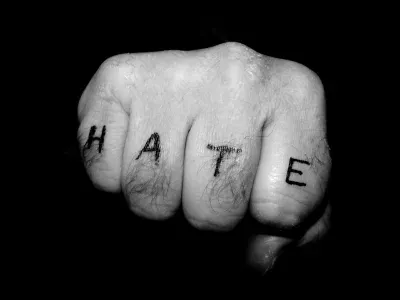
6. "Hate" (Image Credits: By Bifalcucci, <a href="https://commons.wikimedia.org/w/index.php?curid=30918023" target="_blank" rel="noopener">CC BY-SA 3.0</a>)
Those with darker personality traits often use more hostile, negative and disconnected language, including more swear words and anger words, such as “hate” or “mad.” This is one of the more striking findings in computational linguistics research because the correlation holds even in casual, mundane communication, not just during conflicts or emotionally charged discussions. The word surfaces consistently enough to act as a signal.
Vitally, these patterns aren’t usually deliberate. They emerge naturally because language tracks attention, emotion and thought. Someone who sprinkles words like “hate” into routine conversation, describing their commute, their lunch, their workload, may be revealing a habitual orientation toward the world rather than simply having a bad day. The pattern matters more than any single use.
7. "Wonderful"
7. "Wonderful" (Image Credits: Pexels)
In a large-scale analysis of personality and word use among bloggers, agreeable personalities most often used words including “wonderful,” “together,” “visiting,” “morning,” and “spring.” The research by Tal Yarkoni, published in the Journal of Research in Personality and funded by the National Institutes of Health, drew on an enormous dataset and found that this cluster of warm, affiliative words was a reliable marker of high agreeableness as a personality trait.
The association between extraversion and the use of positive emotion words as well as social-related words has been confirmed in a recent meta-analytic study. Words like “wonderful” signal more than politeness. They reflect a genuine attentional bias toward positive social experience. People high in agreeableness don’t just say nicer things because they want to seem likable. Their vocabulary mirrors how they actually perceive and categorize the world around them.
What makes all of this worth sitting with is the reminder that language is not purely a delivery mechanism for conscious intent. When people try to present themselves a certain way, they tend to select what they think are appropriate nouns and verbs, but they are unlikely to control their use of articles and pronouns. These small words create the style of a text, which is less subject to conscious manipulation. The words you reach for reflexively, the ones you never pause to choose, may be doing the most honest work of all.