
For most of modern history, the shape of a serious relationship was fairly predictable. You dated, you eventually moved in, you got engaged, you got married, and at some point you had kids, roughly in that order and mostly outside anyone else's view. That sequence still exists, but almost every step along it now carries a layer of pressure that earlier generations simply didn't have to think about.
Some of that pressure comes from money, some from social media, and some from the fact that couples are reaching these moments later in life than their parents did. Here's a closer look at six familiar milestones that quietly picked up a whole new set of rules.
1. Moving in together now requires a financial plan, not just affection

1. Moving in together now requires a financial plan, not just affection (Image Credits: Unsplash)
Deciding to share an address used to be a fairly simple emotional leap. Now it often functions as a full financial audit, complete with conversations about credit scores, rent splits, and who pays for the couch. The average age for first marriage in the United States has reached 32 years old, a significant increase from previous decades that reflects a trend of Americans delaying marriage compared to earlier generations. That extra time before marriage means cohabitation now often has to carry the practical weight that a wedding once did.
It also means almost everyone does it. Cohabitation before marriage has become the norm, with about four in five recent marriages between 2020 and 2022 preceded by couples living together, a dramatic shift from 1970 when only about one in nine marriages were preceded by cohabitation. Timing has its own set of unspoken rules too. One survey found that just over a quarter of couples believe six to twelve months of dating is the most appropriate window for moving in together. Miss that window and some couples feel behind schedule before they've even signed a lease.
2. The proposal now has to look good on camera

2. The proposal now has to look good on camera (Image Credits: Unsplash)
Getting engaged used to be a private moment between two people, maybe witnessed by a waiter or a confused dog. These days it often doubles as content, staged with lighting, a hidden photographer, or at minimum a phone propped against a rock. The ring itself carries its own updated price tag and set of assumptions.
The average engagement ring cost in the United States sits at roughly $6,500 in 2025, a slight pullback from about $6,775 the year before and well below the five year high of around $9,025 reached in 2022. Lab grown diamonds have changed the math considerably, since lab grown stones now cost roughly half as much as natural diamonds of comparable quality, with figures landing around $5,188 versus $10,760. The old three months' salary rule is largely gone, replaced by a newer, quieter expectation that the moment itself needs to be documentable and, ideally, shareable within the hour.
3. Making it "social media official" became its own milestone

3. Making it "social media official" became its own milestone (Image Credits: Unsplash)
There was a time when telling your friends you were dating someone meant an actual phone call or, at most, a group text. Now there's an entire in between phase where a couple is together in real life but not yet confirmed online, and that gap gets scrutinized. Following each other, tagging each other, and eventually posting a couple photo have all become checkpoints with their own timing anxieties.
The instinct to narrate a relationship publicly shows up clearly in the data. One survey found that nearly half of social media users in a committed but unmarried relationship had used social media to share or discuss their dating life, compared to about a quarter of married users who said the same. That gap suggests the pressure to broadcast is strongest early on, right when a couple is still figuring out what they even are to each other. Deciding when to post, and how much, has quietly become its own relationship conversation that didn't exist a generation ago.
4. Merging bank accounts turned into a negotiation

4. Merging bank accounts turned into a negotiation (Image Credits: Unsplash)
Combining finances used to be an assumed part of settling down. It is no longer automatic, and couples now spend real time debating whether, when, and how much to merge. The share of married couples without any joint bank account rose from about fifteen percent in 1996 to nearly one in four by 2023. Marrying later plays a role here, since couples often arrive with established finances they are reluctant to fully fold together.
Recent surveys back this up. More than half of American couples in relationships keep at least some separation in their finances, and only about thirty eight percent completely combine everything into joint accounts. The generational split is sharp too, since the majority of Gen Z adults, at fifty one percent, keep their finances completely separate, compared with much lower shares among older generations. Where a joint account was once just a wedding gift errand, it now comes loaded with questions about autonomy, trust, and who spent what on the group vacation.
5. The wedding turned into a small scale production
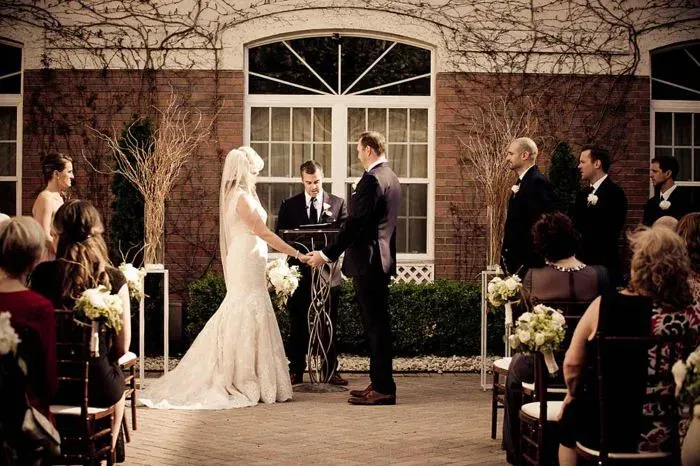
5. The wedding turned into a small scale production (Belvedere Events and Banquets, Flickr, <a href="https://creativecommons.org/licenses/by/2.0/" target="_blank" rel="noopener">CC BY 2.0</a>)
Weddings were never cheap, but the expectations around them have grown considerably more elaborate. The average wedding cost in 2025 held at around $34,000, with couples spending an average of $292 per guest, up from the year before and well above pre pandemic levels. That price now comes with an entire ecosystem of expectations, from welcome bags to multi day itineraries that a smaller, simpler ceremony once never required.
Even the planning process has changed shape. Roughly thirty six percent of engaged couples used artificial intelligence tools to help plan their weddings in 2025, nearly double the share from the year before. Around two million couples still got married in the United States in 2025, treating the wedding as a largely non negotiable milestone despite ongoing economic pressure. The event itself hasn't disappeared, but the bar for what counts as a proper wedding keeps climbing.
6. Having children now comes with a longer checklist

6. Having children now comes with a longer checklist (Image Credits: Pexels)
Parenthood used to follow marriage fairly quickly for most couples. Now it often waits until careers, housing, and savings feel stable enough to support a family, which pushes the timeline out for almost everyone. Data on young adults shows that reaching milestones like living independently, marrying, and having children now happens noticeably later than it did forty years ago, even though the gap in reaching full time employment or financial independence is much smaller.
That delay has reshaped what having a first child is expected to look like. Couples are more likely to arrive at parenthood with established careers, a home already secured, and a fairly detailed plan for childcare already worked out in advance. What used to be a leap of faith increasingly resembles a project with milestones of its own, planned around finances and timing in a way earlier generations rarely needed to.
None of these shifts mean relationships have gotten harder in some fundamental sense. They just carry more visible checkpoints now, shaped by money, timing, and an audience that earlier couples never had to account for. The milestones themselves haven't changed much. What's changed is everything now expected to surround them.