
Every year, millions of people stand in a room full of belongings and try to decide what stays and what goes. The process gets marketed as liberating, even joyful, a chance to start fresh with less baggage and more space to breathe. What rarely makes it into the glossy articles and home makeover shows is how genuinely hard this work is, emotionally and mentally, long before a single box gets packed.
Downsizing and decluttering are often treated as logistical tasks, something you schedule a weekend for and finish with a donation run. The reality, according to researchers who study aging, possessions, and identity, looks a lot messier than that. This article looks at the parts of the process that get glossed over, and why acknowledging them might actually make the whole thing easier.
The grief that gets mistaken for hesitation

The grief that gets mistaken for hesitation (Image Credits: Pexels)
When someone stalls halfway through clearing out a closet, it’s easy to assume they’re being lazy or sentimental in an unproductive way. Research suggests something else is often happening. A study in the Journal of Housing for the Elderly found that 78% of seniors reported experiencing symptoms of grief during downsizing, including sadness and tearfulness when sorting through possessions.
That grief response is real, yet it rarely gets treated as legitimate. Societal expectations frame downsizing as a positive “rightsizing” that should be embraced rather than mourned, and this mismatch between internal emotional experience and external expectation can leave people feeling misunderstood. Calling it hesitation or stubbornness misses the point entirely. People aren’t dragging their feet out of laziness; they’re processing a loss that doesn’t get a funeral or a sympathy card.
A lifetime of stuff: understanding the material convoy

A lifetime of stuff: understanding the material convoy (Image Credits: Unsplash)
There’s a reason a single garage or attic can take months to sort through, and it has nothing to do with willpower. Dr. David Ekerdt, who directs the Gerontology Center at the University of Kansas, coined the term “material convoy” to describe how people accumulate possessions throughout their lives that reflect their identities and relationships. Every object in that convoy is doing quiet work, holding a memory or a version of the person who owned it.
The scale of this accumulation is genuinely staggering once you look at the numbers. Ekerdt’s research indicates that by age 70, many individuals have amassed between 300,000 and 400,000 items, each with its own meaning and memory. Sorting through that isn’t a weekend project. It’s closer to reviewing an entire life, one drawer at a time.
Why decisions about belongings feel harder than they should

Why decisions about belongings feel harder than they should (Image Credits: Pexels)
Anyone who has spent an afternoon deciding whether to keep, donate, sell, or toss a single box of odds and ends knows the exhaustion that sets in. It isn’t physical tiredness so much as a kind of mental static that builds with every choice. Each item requires a small judgment call, and those judgments add up faster than most people expect.
This pattern lines up with what researchers call decision fatigue, the idea that the quality of choices deteriorates after a long stretch of decision-making. Downsizing forces hundreds of these micro-decisions in a single sitting, which is a very different mental load than deciding what to have for dinner. People who quit partway through a decluttering project often aren’t lacking motivation; they’ve simply run out of decision-making capacity for the day.
The guilt trap: keeping things for other people

The guilt trap: keeping things for other people (Image Credits: Pexels)
A surprising amount of clutter isn’t kept out of attachment to the object itself. It’s kept because letting go feels like betraying the person who gave it, made it, or once needed it. Inherited furniture, gifts from family, items tied to a parent or grandparent, these carry a weight that has nothing to do with their usefulness.
This kind of guilt tends to be quieter and more persistent than outright grief, which makes it harder to name and therefore harder to work through. It shows up as vague unease rather than a clear emotion, and it can keep boxes sealed in a garage for years without anyone quite admitting why. Recognizing that the guilt is about the relationship, not the object, is often the first real step toward letting something go.
Nobody wants your china: the generational mismatch

Nobody wants your china: the generational mismatch (Image Credits: Unsplash)
One of the more deflating moments in downsizing happens when an adult child politely declines the china cabinet, the piano, or the box of vinyl records that once felt irreplaceable. It isn’t rejection of the parent or the memory attached to the item. It’s simply a mismatch between what one generation valued and what the next generation has room for, both physically and in terms of lifestyle.
This mismatch is one of the least discussed parts of the whole process, and it can sting more than people expect going in. Many families discover that heirlooms carry deep meaning for the person letting go but very little practical or emotional pull for the person meant to inherit them. Naming this gap early, rather than assuming children automatically want everything, tends to save a lot of hurt feelings later.
Voluntary choice changes everything

Voluntary choice changes everything (Image Credits: Pexels)
Not all downsizing happens on the same terms, and that distinction matters more than most people realize. A longitudinal study by the University of Michigan found that seniors who perceived their housing transitions as voluntary reported significantly better psychological outcomes 12 months post-move than those who felt the decision was externally imposed. The move itself might look identical from the outside, yet the emotional aftermath can be completely different depending on who made the call.
Research on push and pull factors backs this up from another angle. Placing greater importance on push relative to pull factors was associated with lower levels of well-being in three domains: environmental mastery, purpose in life, and self-acceptance. In plain terms, being pushed out by health problems or family pressure tends to hurt more than choosing to move toward something you actually want.
Money is rarely the only motive

Money is rarely the only motive (Image Credits: Unsplash)
Financial reasons get cited constantly as the driver behind downsizing, and they’re not wrong exactly, just incomplete. Smaller homes mean lower utility bills, less maintenance, and often a lump sum from selling a larger property. Yet when people are asked what actually pushed them to act, the picture gets more complicated than a spreadsheet.
Timing also plays a bigger role than most people admit going in. Studies show that 51 percent of retirees ages 50 and over move into smaller homes after retirement, yet 64 percent initially plan to stay put, which means the decision often comes later and faster than expected. That gap between intention and action explains why so many downsizing projects end up rushed, crisis-driven, and far more stressful than they needed to be.
The physical and mental toll of staying put
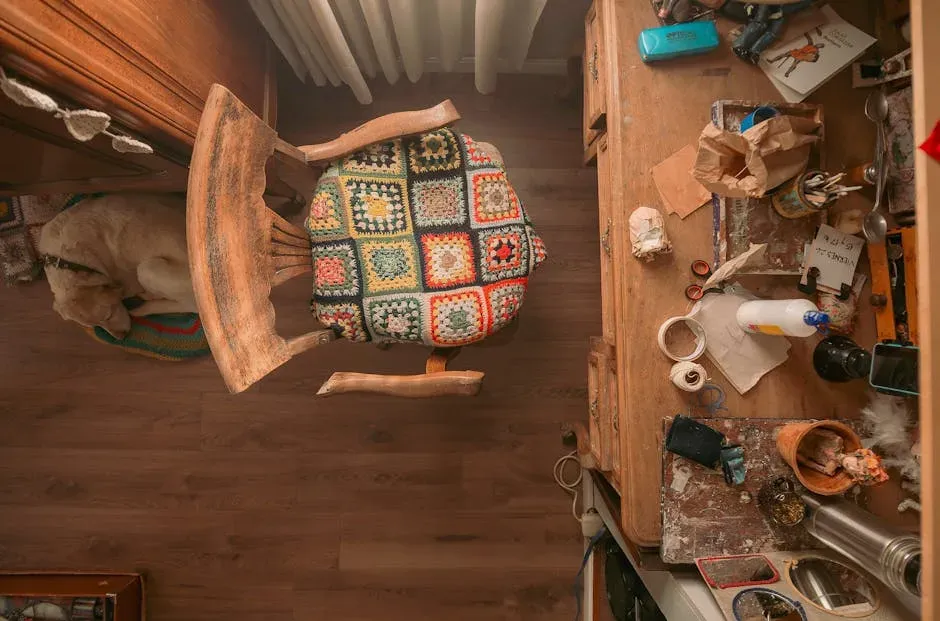
The physical and mental toll of staying put (Image Credits: Pexels)
Clutter doesn’t just sit there quietly waiting to be organized someday. It has a measurable physiological cost, according to researchers who’ve looked at stress hormones in cluttered versus organized homes. Research from UCLA’s Center on Everyday Lives of Families found that people, especially women, who live in cluttered environments tend to have consistently higher levels of cortisol, the stress hormone.
For older adults specifically, there’s also a practical safety angle that gets less attention than the emotional side. A cluttered home isn’t just visually overwhelming; it raises the risk of falls and tripping hazards, a concern that grows more serious with age. The decision to delay downsizing, in other words, isn’t a neutral choice. It carries its own quiet risks, even if they’re less obvious than the discomfort of sorting through old boxes.
Doing it in stages beats doing it in crisis

Doing it in stages beats doing it in crisis (Image Credits: Pexels)
Families who wait until a health emergency or sudden move forces the issue tend to describe the experience very differently from those who start early. Families who approach downsizing as a gradual, intentional process report significantly less conflict than those facing crisis-driven clearouts. There’s a meaningful difference between choosing to sort through a closet on a random Saturday and being handed forty-eight hours to clear out a house.
Part of the reason gradual downsizing works better is that it allows for the grief and guilt discussed earlier to surface in manageable doses, rather than all at once under pressure. It also gives people time to actually offer items to family or charities that will use them, rather than making rushed decisions in a dumpster line. Nobody plans for the crisis version, yet without an early start, that’s often what ends up happening by default.
The relief is real, but it takes longer to arrive than people expect

The relief is real, but it takes longer to arrive than people expect (By Shixart1985, <a href="https://commons.wikimedia.org/w/index.php?curid=186373605" target="_blank" rel="noopener">CC BY 2.0</a>)
Here’s the part that tends to get buried under all the difficulty: most people who go through with downsizing do eventually feel better, sometimes dramatically so. Research indicates that 64% report relief after downsizing, knowing they’ve spared their families difficult decisions. That’s a real, well-documented outcome, not just a comforting story people tell themselves afterward.
The catch is that relief doesn’t usually show up on moving day. It tends to arrive weeks or months later, after the grief has had time to settle and the new space has started to feel lived-in rather than just smaller. Many older adults report that knowing they’ve proactively managed their possessions provides peace of mind regarding family responsibilities. The uncomfortable middle stretch is temporary, even when it doesn’t feel that way at the time.
Final thoughts

Final thoughts (Image Credits: Pexels)
Downsizing and decluttering get sold as simple acts of tidying, when really they touch on identity, family relationships, and how people make peace with the passage of time. None of that makes the process impossible or something to dread indefinitely. It just means the emotional weight deserves as much planning as the logistics do, rather than being treated as an inconvenient side effect to push through as quickly as possible.
The people who seem to fare best aren’t the ones who move fastest or feel the least attachment to their things. They’re the ones who give themselves permission to find it hard, take it in stages, and trust that the relief on the other side is worth the discomfort of getting there.